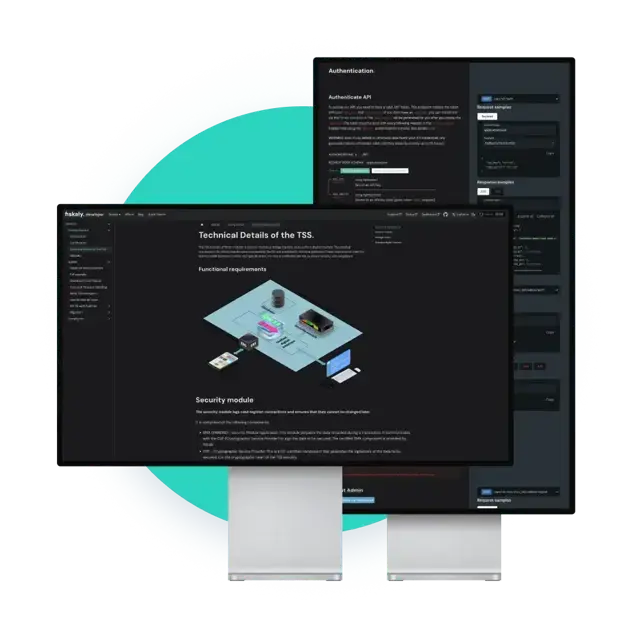
What's included
Redundant by design
Dual data centers, active/active failover — not a single point of failure between your POS and Skatteverket.
Certified twice over
Live on SKVFS 2020:9, with a separate certified cluster still running the older 2009:2 standard for anyone who needs it.
Fast enough not to notice
Typical turnaround under 0.2 seconds per transaction — the X.509 certificate security toward the Swedish control system is handled entirely by fiskaly in the background.
Self-service register management
A web console (IDM) to enroll, pause, or remove registers — plus the same actions by Excel upload or API, if that fits your workflow better.
Pay for what you use
A base subscription covers support and your test environment; beyond that, you pay per connected register per month.
Integration steps
- API guide
Our onboarding team walks you through the integration itself — what to send, what you get back, and the edge cases worth knowing about upfront. (The separate legal step — self-declaring to Skatteverket — is covered on the VAT reporting page →, since that's a regulatory requirement, not something we do to your code.)
- Test environment
You run every VAT scenario your business needs against a sandbox until it checks out. This is also where we confirm your receipt text matches Swedish requirements.
- Setup & production
Enrollment API training, validated certificates, access to the production endpoint, and a live status page so you can see what we see. Most teams get through this in a few weeks — it depends more on how much of your existing transaction logic needs adjusting than on the API itself.
Managing registers at scale
If you're running ten registers, a spreadsheet might work. If you're running ten thousand across multiple merchants, it doesn't — so we built an actual system for it.
Registers are organized in a hierarchy that mirrors your business — chain, store, register — with each individual register getting a unique identity it has to use whenever it calls the API. You (or delegated administrators) can enroll, pause, or remove registers three ways: through the web console directly, via an Excel upload for bulk changes, or through the enrollment API if you want it fully automated on your side.

Frequently asked questions
If it can make an internet connection and call an API, yes. We're not tied to any specific POS software, payment stack, or hardware.
Most teams get through the API guide and test environment in a few weeks. The bigger variable is how much your existing receipt/transaction logic needs to change to match Swedish VAT requirements — our onboarding team runs the test cases with you rather than leaving you with documentation alone.
Fully self-service if you want it — web console, Excel upload, or API, your choice. Nobody has to email us a spreadsheet.