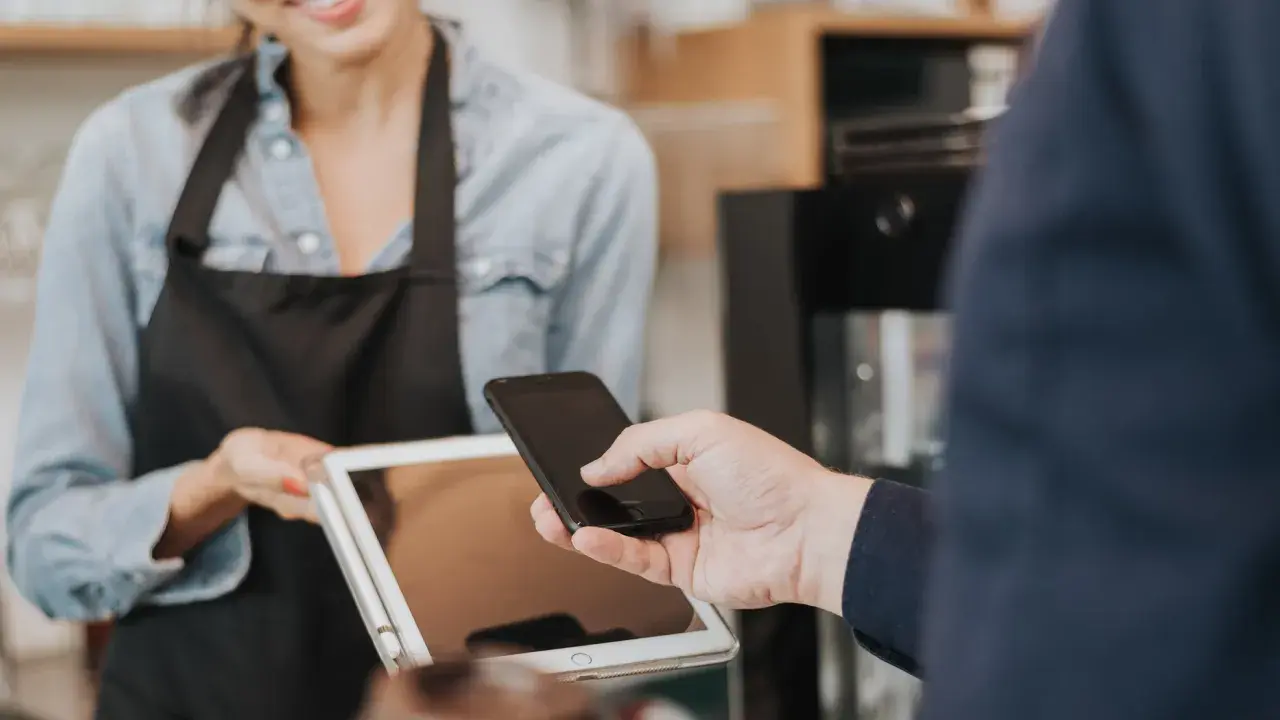
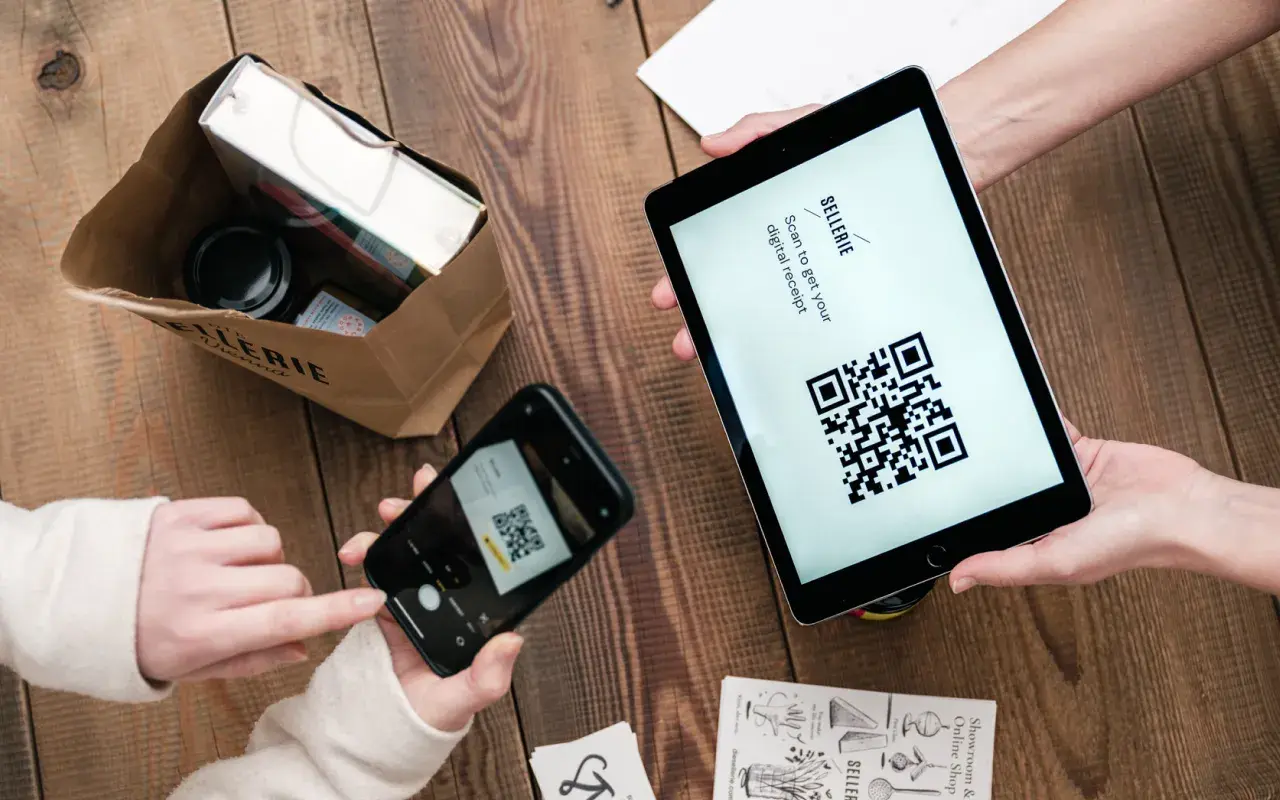
A digital receipt is far more than a paper replacement. It is a compliance tool, a marketing channel, and a customer experience upgrade — all delivered through a single QR code or tap. With France moving to digital-by-default receipts, Italy phasing in mandatory electronic receipts, and receipt obligation discussions in Austria and Germany, the shift from paper to digital is a change worth looking at for most European businesses.
This guide explains what a digital receipt is, how it works, and where it delivers the most value. You will find concrete use cases across retail, hospitality, quick-service restaurants, and mobile services, a side-by-side comparison with paper receipts, and answers to the questions compliance and finance teams ask most often.
What is a digital receipt?
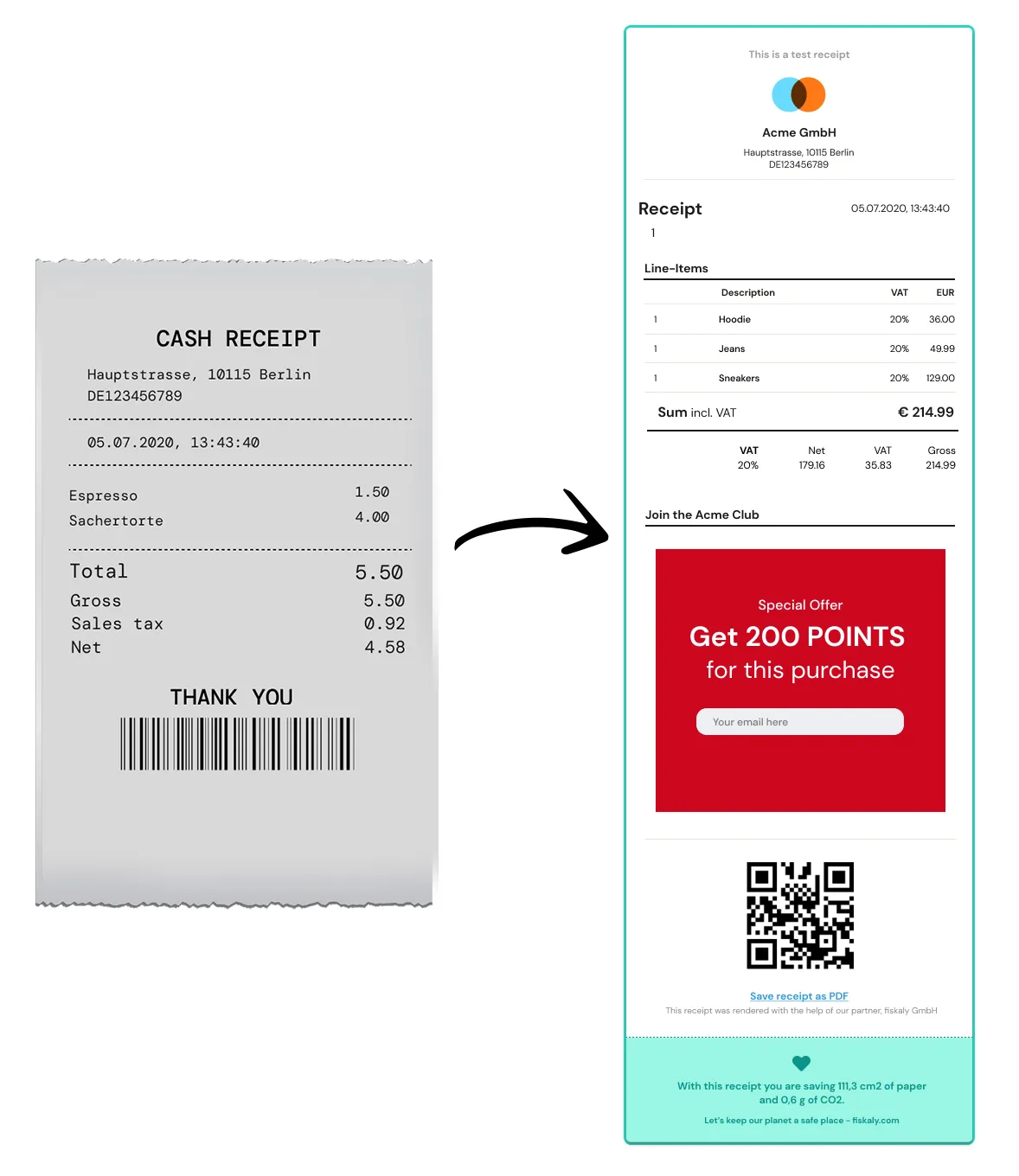
A digital receipt — also called an electronic receipt, e-receipt or paperless receipt — is a legally compliant record of a transaction delivered to the customer in digital form. Instead of being printed on thermal paper, it is issued via QR code, email, a wallet app such as Apple Wallet or Google Wallet, or a direct link at the point of sale.
Under the hood, a digital receipt carries exactly the same transaction data as a paper receipt: item list, prices, VAT breakdown, payment method, timestamp, and the seller's tax details. In regulated markets it is also signed and archived to meet fiscal requirements, for example the German KassenSichV or Italy's corrispettivi telematici.
For businesses, that single digital artifact unlocks benefits paper receipts never could: dynamic content, integrated marketing, analytics, automatic archiving, and a richer customer experience.
How do digital receipts work?
The flow is simple and works with almost any POS system:
- The customer completes a transaction at the register, mobile POS, or online checkout.
- The POS sends the receipt data to a digital receipt API such as fiskaly RECEIPT.
- A receipt link is generated — typically a QR code shown on the POS screen. No personal data is required to issue the receipt.
- The customer accesses the receipt by scanning the QR code or receiving the receipt automatically in their customer app or wallet app via card linking.
- The receipt is stored in the cloud and remains available to both the customer and the merchant for the required retention period.
Because the receipt lives online, the merchant can update its look, add promotional blocks, or attach warranty information long after the transaction is complete. The customer can pull it up whenever they need it — no lost paper, no faded thermal print.
What are the benefits of digital receipts?
Before jumping into industry examples, it is worth isolating the outcomes businesses report most consistently after rolling out digital receipts:
- Compliance coverage: In regulated markets, a digital receipt issued through a certified provider is fully equivalent to a paper receipt. In markets such as France, it is becoming the default.
- Lower operating cost: Thermal paper rolls, printers, maintenance, and BPA-free compliance add up. Digital receipts remove that entire line item.
- Sustainability: Paper receipts are one of the most visible forms of single-use waste at checkout. A digital alternative is a measurable ESG improvement — and one your customers can see.
- A new marketing channel: Every receipt becomes a branded touchpoint – logo, product images, personalized offers, loyalty sign-up, and product recommendations.
- Dynamic content: Unlike paper, a digital receipt can be updated after issuance. Yesterday's advertising block is tomorrow's promotion.
- Analytics: A digital receipt tells you when it was opened, how often it was revisited, and which content was clicked. Paper tells you nothing.
- Customer experience: No more faded paper, no more dedicated receipt folders, no awkward requests for a printed copy. The receipt is always in the customer's pocket.
Digital receipt use cases by industry
A digital receipt behaves differently depending on the environment. These are the scenarios where the business case is strongest.
➡️ Retail: From receipt to brand experience
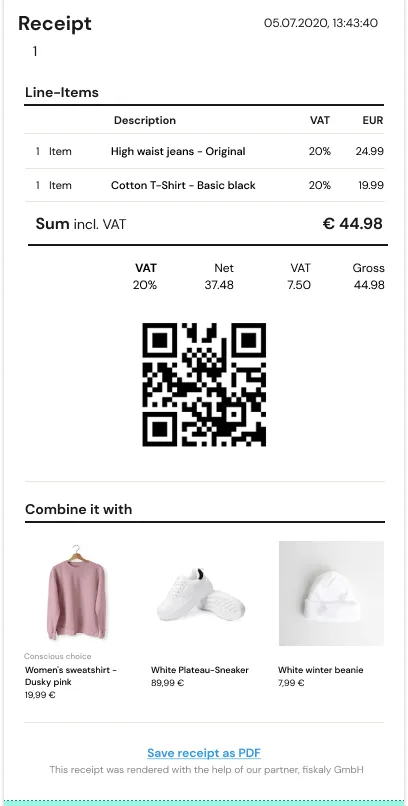
Imagine buying a €500 piece of outerwear and receiving a cluttered, low-contrast thermal-paper strip. The purchase feels premium; the receipt does not. A digital receipt closes that gap: consistent typography, brand colors, a high-resolution logo, and the same look and feel as the e-commerce side of the business.
Beyond branding, retailers use digital receipts for:
- Product recommendations. Someone who bought a winter jacket sees a matching beanie in the receipt's recommendation block the next time they open it.
- Warranty and returns. The receipt itself becomes the proof of purchase. No lost paper, no friction at returns.
- Loyalty program enrollment. A one-tap opt-in from the receipt itself, with no extra form at the register.
- Post-purchase campaigns. Because receipts can be updated, a seasonal sale banner can appear weeks after the original purchase.
➡️ Hospitality: Faster service
In a typical restaurant there is one central cash register and many mobile order devices. Waitstaff run back and forth just to print a bill at the end of service. Digital receipts eliminate that bottleneck — the check is generated on the handheld, the QR code appears on the device, and the guest scans it at the table while paying contactlessly.
➡️ Services and mobility: Where paper always hurt most
Cabs, mobile massage therapists, in-home physiotherapy, on-site technicians — anywhere the provider arrives at the customer, receipt printing has always been lengthy. A dedicated thermal printer is either carried around or skipped entirely, and a typical taxi receipt print can take a third of the trip's duration.
A digital receipt changes the interaction. A static QR code on the vehicle or service kit is all that is needed. The customer scans once, the receipt is issued, and — for business travel — it can be pushed directly into the corporate expense system. For fleet operators and service marketplaces this removes a long-standing reconciliation headache.
➡️ B2B and expense management: Fewer paper lumps in envelopes
Around 10% of cars registered in Germany are company cars — roughly 5.15 million vehicles. Every fuel stop used to end with a crumpled paper receipt that someone, eventually, had to key into an expense system. A digital receipt issued at the pump and pushed directly into the employee's expense tool short-circuits that entire process.
The same logic applies to hotel check-outs, car rentals, office supplies, and client dinners. A digital receipt is structured data; a paper receipt is an image someone has to transcribe.
➡️ Gas stations and self-service: Paperless at scale
Petrol stations, parking garages, EV charging points, and unmanned stores have an unusual receipt problem — a printer at every point of sale is expensive, prone to jams, and often unused. A QR code on the pump or terminal removes the printer entirely. Customers who want a receipt scan; customers who do not simply drive off, with the receipt stored against their payment card in case they need it later.
Paper vs digital receipts: A side-by-side comparison
Issuance cost
- Paper receipts: Thermal paper, printer, maintenance
- ✅ Digital receipts: No consumables, no hardware
Environmental impact
- Paper receipts: Single-use waste, often coated
- ✅ Digital receipts: Zero paper, low energy footprint
Customer storage
- Paper receipts: Fades, gets lost, manual filing
- ✅ Digital receipts: Wallet apps, searchable, permanent
Branding
- Paper receipts: Monochrome, low resolution
- ✅ Digital receipts: Full brand expression, dynamic visuals
Updateable after issuance
- Paper receipts: No
- ✅ Digital receipts: Yes — content can refresh for years
Marketing value
- Paper receipts: Limited space, static
- ✅ Digital receipts: Recommendations, offers, loyalty, CTAs
Analytics
- Paper receipts: None
- ✅ Digital receipts: Opens, re-opens, click tracking
Compliance archiving
- Paper receipts: Manual, error-prone
- ✅ Digital receipts: Automatic, audit-ready
Digital receipts and European compliance
Digital receipts are not just a product decision, they are increasingly also a regulatory one. The European landscape in 2026 looks like this:
- France has shifted to a digital-by-default receipt: paper receipts are no longer printed automatically and must be explicitly requested.
- Italy is phasing in electronic receipts as part of the country's corrispettivi telematici framework. Receipts are sent to the Agenzia delle Entrate in real time.
- Germany is awaiting a pending ECJ decision on the general receipt obligation (Belegausgabepflicht). Meanwhile, digital receipts remain fully KassenSichV-compliant when issued through a certified provider.
- Spain and Austria have no blanket digital receipt mandate yet, but digital receipts are recognized as legally equivalent under existing fiscal law.
For a country-by-country view of the rules, dates, and what they mean for merchants and POS vendors, see our overview of Europe's shift to electronic receipts.
The takeaway for POS vendors and omni-channel operators: digital receipts are moving from a nice-to-have to a compliance foundation. The markets where the transition is fastest are also the markets where paper infrastructure is most expensive to maintain.
How fiskaly RECEIPT fits in
fiskaly RECEIPT is a cloud-based API that issues legally compliant digital receipts across Europe. It is ISO 27001 certified, GDPR-compliant, and integrates with Apple Wallet, Google Wallet, and Mastercard automatic receipt delivery. For POS vendors, the integration is a single API that covers paper replacement, receipt branding, custom sections, wallet delivery, and merchant-side analytics out of the box.
When paired with fiskaly SIGN for fiscal signing and fiskaly SAFE for archiving, the same transaction data flows from the register to a signed, stored, and customer-accessible digital receipt without the merchant having to stitch it together themselves.