
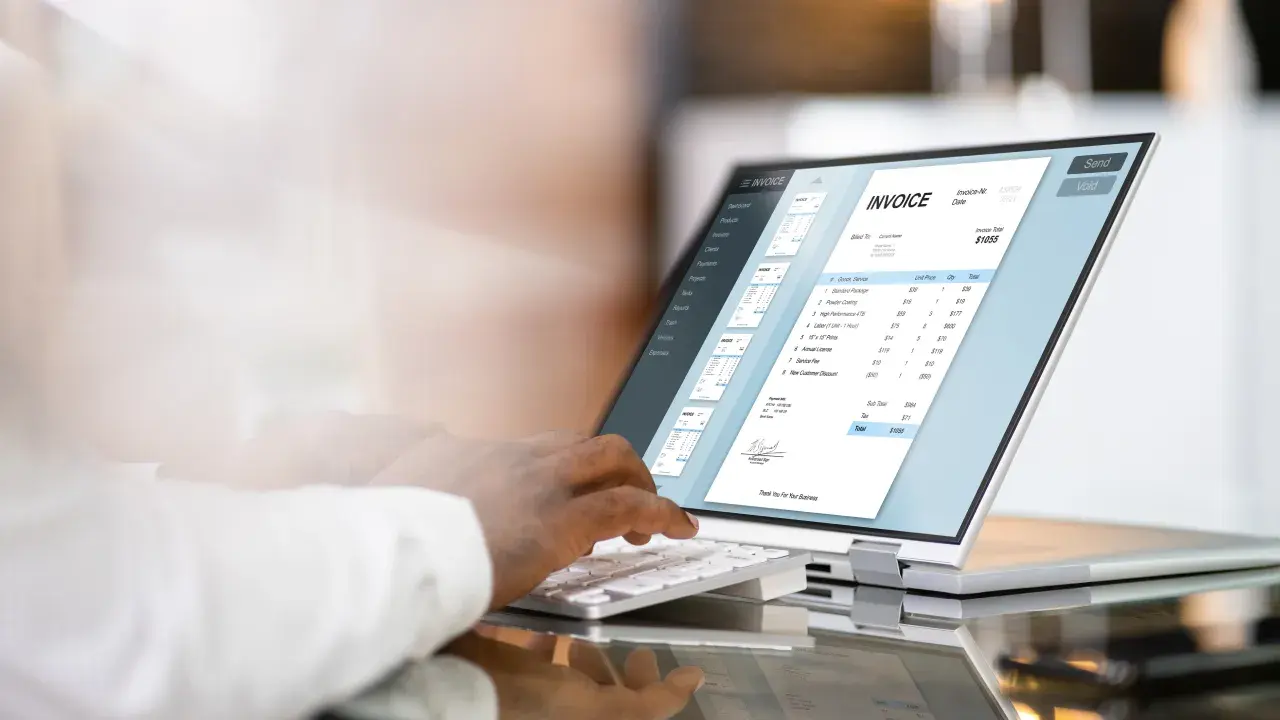
On October 15, 2025, the German Federal Ministry of Finance (BMF) published a letter amending the VAT Application Decree (Umsatzsteuer-Anwendungserlass), clarifying the requirements for mandatory electronic invoicing for transactions between domestic businesses. The updates focus on errors related to format, business rules, and content, as well as their consequences.
The introduction of mandatory e-invoicing for transactions between domestic businesses as of January 1, 2025 marks a strategic turning point in the digitalization of the German economy. This transition not only increases transparency but also transfers new and extended due-diligence obligations to the invoice recipient. Correct processing of incoming electronic invoices is essential to ensure compliance with legal requirements and to safeguard input tax deduction.
What is meant by an electronic invoice?
👉 E-invoice
An e-invoice is an invoice issued, transmitted, and received in a structured electronic format that enables electronic processing (VAT Application Decree, UStAE 14.1 para. 2).
Permitted formats are:
- Formats that comply with the European standard EN 16931.
- Formats that have been agreed upon between the invoice issuer and recipient and allow correct and complete extraction of the required data.
👉 Other invoice
“Other invoices” include invoices in paper form or other electronic formats that do not meet the requirements for an e-invoice.
Examples of other electronic invoice formats include PDF files without embedded data sets and image files.
💡 Important
A file that fails to meet the requirements of a structured format due to format errors is also considered an other invoice.
What are the most common errors in electronic invoicing?
The correct classification of a document as an “e-invoice” or “other invoice” is the first and most important step, as it determines the entire subsequent verification process and has direct VAT implications. Based on this, there are three common categories of errors that companies need to watch for.
❌ Format errors
A format error occurs when an invoice file does not comply with the technical syntax requirements or does not allow correct and complete extraction of the data.
- Example: A faulty XML structure.
- Consequence: The file is not considered an e-invoice for VAT purposes but an “other invoice.” This may conflict with the issuer’s obligation to send an e-invoice.
❌ Business rule errors
These are violations of the logical dependencies of information within an e-invoice. Business rules are technical provisions that check data consistency.
- Examples: Incomplete information (e.g., a mandatory field such as “BT-10 Buyer reference” is missing) or contradictory information (e.g., the calculated tax amount does not match the indicated tax rate).
- Consequence: Some of these errors may be relevant for VAT purposes (e.g., incorrect tax calculation), while others (e.g., missing “Buyer reference”) may be irrelevant for VAT. An individual assessment is required.
💡 Practical Tip
Not every business rule error requires invoice rejection. It is recommended to establish an internal control procedure that divides errors into two categories: Critical errors that are VAT-relevant (e.g., incorrect tax calculation) and require immediate clarification, and non-critical errors that can be ignored or communicated to the supplier in a batch process (e.g., missing optional reference fields).
❌ Content errors
A content error is a violation of the mandatory VAT information requirements under §§ 14 and 14a UStG. This concerns the material accuracy of the invoice data.
- Examples: Incorrect tax rate, insufficient service description, or missing tax number of the issuer. A content error may also occur even if the file is technically valid (no format or business rule errors).
- Consequence: The invoice is considered “not properly issued,” which may endanger the right to deduct input tax.
✅️ How to check your E-invoices in 3 steps
A systematic and traceable verification process is key to minimizing risks and ensuring compliance. This covers all relevant aspects—from technical validation to content review and secure archiving.
1️⃣ Formal and technical validation
The first step focuses on ensuring technical readiness for sending and receiving, as well as checking for format and business rule errors. It forms the technical foundation for further processing.
Ideally, this step is automated using a “suitable validation application,” as repeatedly recommended in the BMF letter. Such software helps by:
- Ensuring sending and receiving readiness: Integration of a suitable application provider ensures that e-invoices are sent correctly and that readiness to receive them exists at all times.
- Format check: The application verifies whether the received file complies with the technical specifications of an allowed structured format (e.g., conformity with the XML schema of EN 16931).
- Business rule check: Ideally, the application checks extracted data for logical consistency and completeness according to the defined business rules of the respective format
Based on this validation, further steps follow:
- In the case of format errors: The invoice is legally considered an “other invoice.” The recipient must check whether this aligns with the issuer’s obligation to send an e-invoice.
- In the case of business rule errors: The identified errors must be evaluated. Some may be VAT-relevant (e.g., inconsistent tax calculation), while others may be ignored (e.g., missing entry in field “BT-10 Buyer reference”).
- If the check is passed: The invoice has cleared the first technical hurdle. It is formally an e-invoice and can proceed to content and commercial review.
2️⃣ Content and commercial review
Successful technical validation does not release the invoice recipient from the duty of care to review the invoice content. A technically flawless file may still contain incorrect or incomplete information.
Key review points in this step go beyond purely automated validation.
- Completeness of mandatory information: It must be ensured that all VAT-relevant mandatory data according to §§ 14 and 14a UStG are contained in the structured part of the e-invoice. A reference to an attachment with core data is not sufficient.
- Material accuracy: The content accuracy of the data must be checked. Is the tax rate correct? Is the service description accurate and comprehensible? Is the invoice mathematically correct?
- Reconciliation with the business transaction: The invoice data must be matched with the underlying business documents (e.g., order, contract, delivery note). This creates a reliable audit trail between the invoice and the actual service provided.
3️⃣ Documentation and proper archiving
After successful technical and content checks, proper documentation and archiving complete the process. This step is crucial for providing evidence during future tax audits.
Key requirements for archiving e-invoices:
- Retention of the validation report: It is recommended to keep the validation report as proof of the technical verification performed.
- Archiving in the original format: At least the structured part of an e-invoice must be stored in its original, unaltered form. A mere conversion to another format (e.g., PDF archive) is insufficient.
- Ensuring authenticity, integrity, and readability: These three principles must be guaranteed throughout the statutory retention period of ten years. (Note: While the BMF letter mentions eight years, the statutory retention period under § 14b para. 1 UStG is ten years. For legal certainty, the ten-year period is recommended.)
- Machine readability: The structured part must remain machine-readable for the tax authorities to enable digital access during an audit.
The duty of care lies with the invoice recipient
In the e-invoicing process, the invoice recipient bears core responsibility that goes beyond merely receiving a document. They are obligated to perform active verification and control actions to secure input tax deduction and ensure compliance.
Particularly when establishing technical readiness for sending and receiving, automating technical validation, and archiving e-invoices and other records, a reliable partner can save significant effort. The transition to e-invoicing not only introduces new compliance requirements but also presents an opportunity to modernize and increase the efficiency of your invoicing processes.