

4.9% Tax Rate Austria: RKSV-Compliant with fiskaly SIGN AT
From 1 July 2026, Austria will introduce a new reduced VAT rate of 4.9%. The announcement by the tax authorities is raising many questions among cash register operators and software providers: What needs to be adjusted? How much effort is involved? And will I be RKSV-compliant in time?
We have the answers – and the good news upfront:
Minimal Effort Thanks to fiskaly SIGN AT
For everyone already using fiskaly SIGN AT, the technical effort is minimal. In principle, nothing needs to change in the existing implementation. Important: The cash register system must, however, be able to display both tax rates (19% and 4.9%) explicitly and separately – both on the receipt and in reporting.
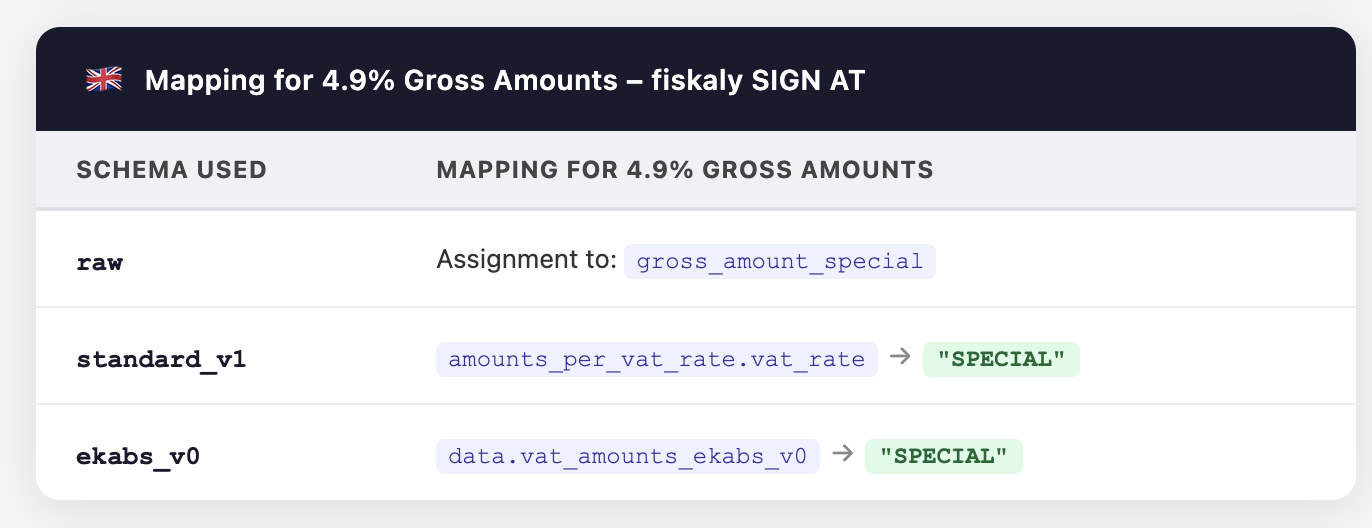
What is required: the correct mapping of gross amounts for the new products in your own code – a manageable adjustment that can be implemented quickly.
Since from July 2026 both tax rates will be assigned to the same tax container ("Betrag-Satz-Besonders"), the tax rate can no longer be automatically derived from the container. Depending on the existing implementation of the TSS, this may lead to considerable additional effort in the cash register system.
fiskaly handles the complex infrastructure in the background as usual: signature creation, data collection log (DEP) and communication with the authorities. Your focus stays on your core business.
How the Mapping Works
The 4.9% tax rate falls technically under the category "Betrag-Satz-Besonders". Gross amounts are mapped as follows depending on the schema used:
The Key Facts at a Glance
Mixed operations:
For businesses invoicing both 19% and 4.9% VAT: both amounts end up together in the "Special" column of the DEP – this is explicitly provided for by the authorities and applies within the scope of fiscalisation. Important: The cash register system must still be able to evaluate and report revenues separately by tax rate, as this continues to be required for the recording and registration system (TSS).
Receipt printing:
Pursuant to § 11 RKSV, the 4.9% rate must continue to be shown separately and explicitly on the cash receipt. There are no exceptions.
Timeline & Testing:
The official amendment is expected in March 2026. However, the tax authorities' existing verification tool is already available for advance testing – we recommend making use of this opportunity early.
Not yet a fiskaly SIGN AT customer?
If you would like to use the transition to the new tax rate as an opportunity to future-proof your cash register solution – now is a good time. With fiskaly SIGN AT, you get a reliable, authority-compliant signature solution that has you covered not only for this change, but for all future RKSV requirements.
Our team supports you from integration through to go-live – straightforward, fast, and with direct support. Get in touch, we are happy to help you stay compliant and ready to go – before the new tax rate comes into effect.
Conclusion
The new 4.9% tax rate brings no significant additional effort for fiskaly SIGN AT customers. An adjustment in the mapping, a quick test with the authorities' verification tool – and you are ready for July 2026. Anyone wishing to take the opportunity to fundamentally modernise their cash register solution will find the right partner in fiskaly.
For questions about mapping, integration, or getting started as a new customer, the fiskaly team is available at any time.