













• 100% cloud-based
  • ISO 27001 certified

E-invoicing in Belgium: compliance one integration away

Belgium requires structured e-invoices for every domestic B2B transaction, exchanged over the Peppol network. fiskaly E-INVOICE makes your POS or ERP system Peppol-compliant through one documented API.

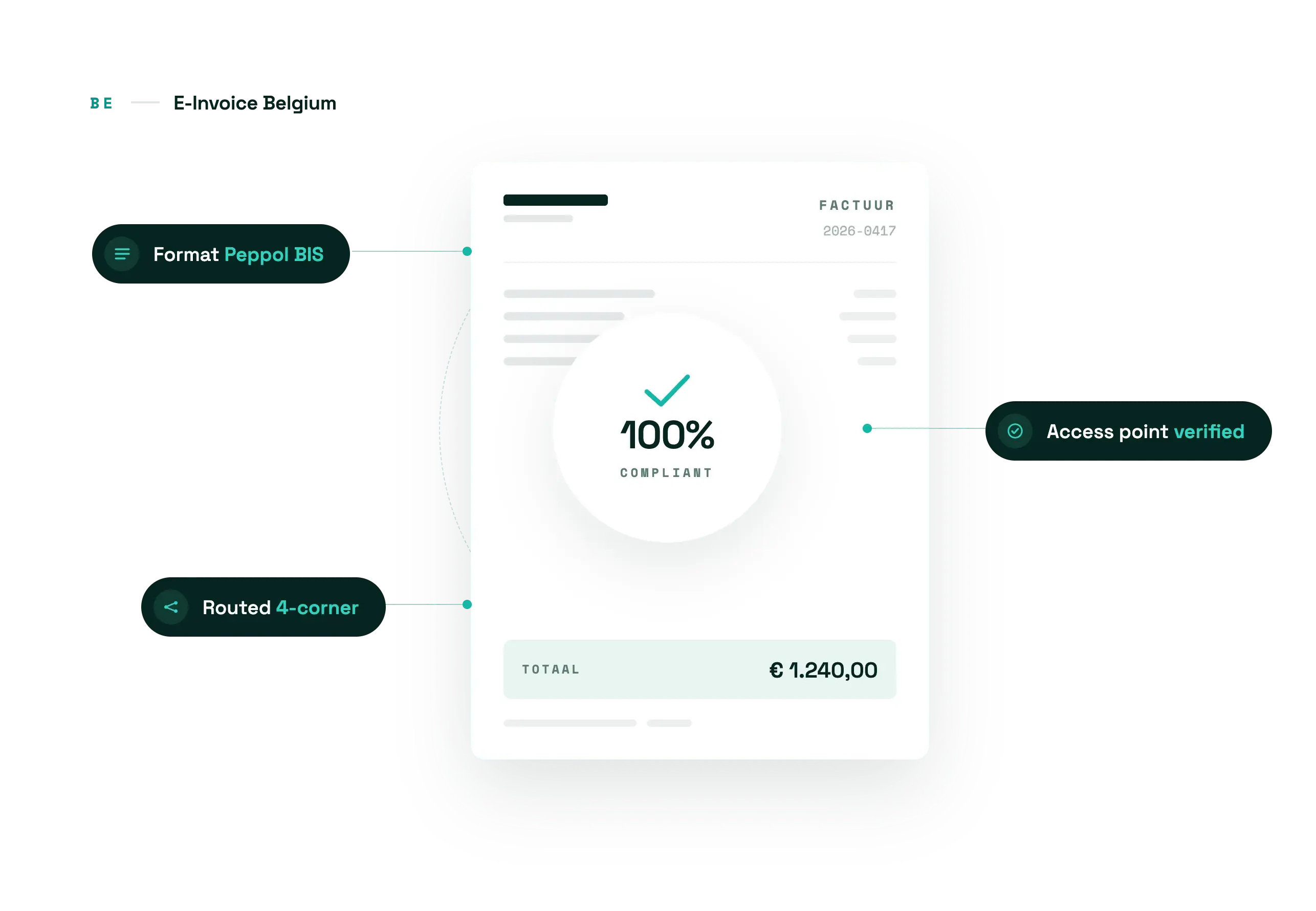
Illustration of a structured e-invoice being validated and reported with fiskaly E-INVOICE
SumUp logoCloudbeds logoOracle Gold Partner logoUber logoRoomRaccoon logoShopify logoElo logoLittle Hotelier logoeviivo logoorderbird logoMarkant logoYurest logo

Belgium's B2B e-invoicing mandate, explained

Since 1 January 2026, every VAT-registered business established in Belgium must issue and receive structured e-invoices for domestic B2B transactions. PDF and paper no longer qualify. Our guide to the mandate covers scope and timelines; the government’s own guidance sits on the Belgian e-invoicing portal.

Retail and hospitality invoicing process affected by Belgium's B2B e-invoicing mandate
  • In force since1 January 2026

    All VAT-registered businesses established in Belgium, for domestic B2B. Extends the B2G mandate live since 2024.

  • FormatPeppol BIS Billing 3.0

    UBL 2.1, aligned with EN 16931. Belgium imposes no national CIUS, so invoices stay interoperable across Europe.

  • NetworkFour-corner Peppol

    Access point to access point, with no government clearance and no pre-issuance validation by the tax authority.

  • Archiving10 years

    The original structured UBL/XML file, not a PDF rendition. Cloud storage and other EU member states are allowed.

  • Penalties€1,500 to €5,000

    Progressive per infringement since the tolerance period ended on 31 March 2026. Buyers can also lose their input VAT deduction.

  • Next up1 January 2028

    Near-real-time e-reporting through a five-corner Peppol model. The annual client listing is expected to disappear.

How fiskaly helps POS and ERP vendors in Belgium

fiskaly E-INVOICE is built for POS and ERP vendors that have to support Belgium’s mandate without building Peppol connectivity themselves. Your team keeps shipping invoicing features; we maintain the compliance layer underneath — and the same integration extends to the next mandate in Europe.

Software developers validating structured e-invoices before Peppol transmission

Why
fiskaly.
E-INVOICE for Belgium

Check out the FAQs
  • Built for Belgium's Peppol mandate

    Issue and receive Peppol BIS Billing 3.0 e-invoices out of the box, fully aligned with EN 16931. Credit notes reference the original invoice, as Belgian rules require.

  • Peppol connectivity without your own access point

    Reach every Belgian recipient through our network connection. Participants resolve by enterprise number (KBO/BCE, scheme 0208) — you never become an access point.

  • One API, fully documented

    Integrate in days rather than quarters: a clean REST API, a free sandbox, quickstart guides, and support from engineers who know the mandate.

  • Invoice validation built in

    Automated checks confirm every invoice meets Belgian format and structure rules before it leaves your system, so rejections never reach your customers.

  • Automatic regulatory updates

    Belgium adds near-real-time e-reporting in 2028. We ship the changes as the rules evolve — your integration stays exactly as it is.

  • One integration, many markets

    E-INVOICE is part of our unified VAT compliance platform: once live in Belgium, adding Germany, France, Italy, or Spain needs no new integration.

  • Certified for security and quality

    Tax data deserves enterprise-grade handling. fiskaly is ISO 27001 and ISO 9001 certified for security and quality management.

We speak technology

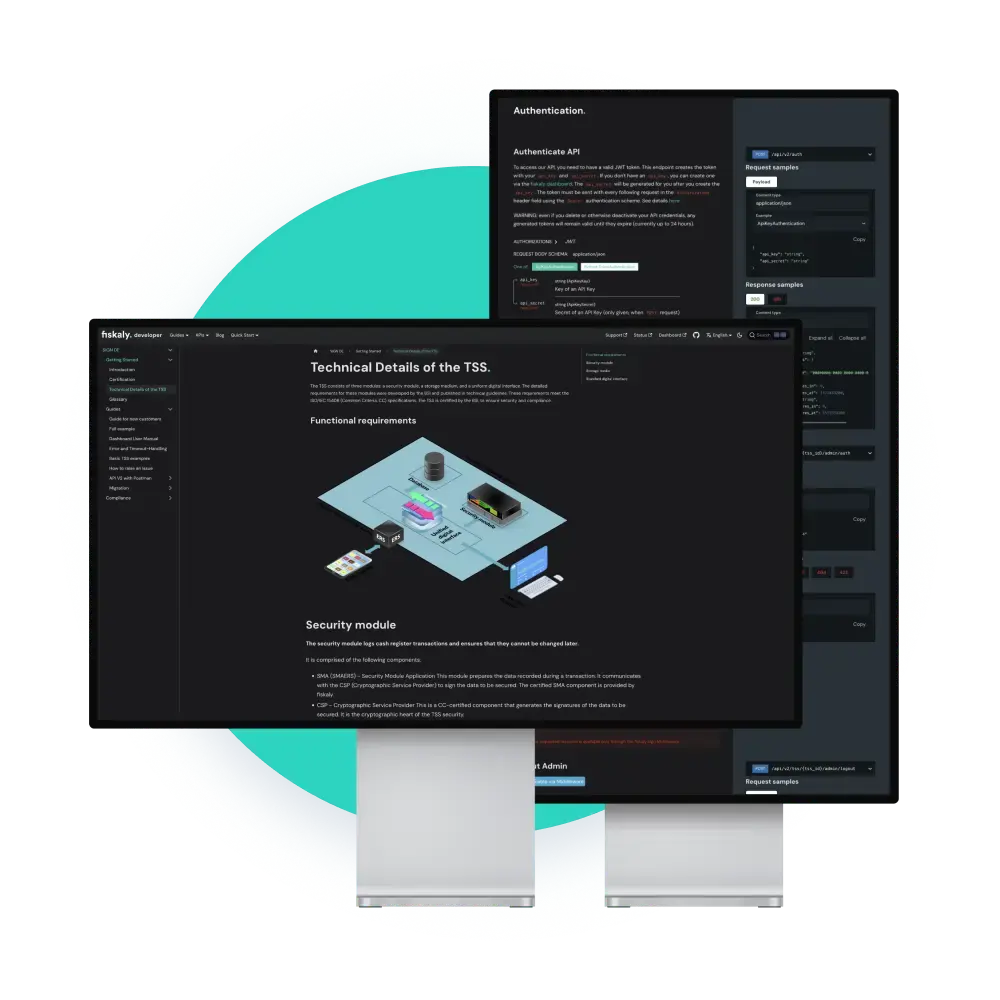
Peppol participant identifiers, recipient validation, credentials, format edge cases — our developer workspace has the answers, with step-by-step integration guides, the full API reference, and a ready-to-use Belgium example.

Computer monitors with the fiskaly developer workspace and E-INVOICE API documentation
  • over

    10 billion

    digital signatures

  • active in

    1 million

    POS

  • over

    97%

    satisfaction rate

Interested? Request a first meeting

  • We're here to help with any questions and find the perfect solution.
  • Over 1,900 customers trust our fiscalization solutions. We've got you covered!

Optional

Optional

FAQs about e-invoicing in Belgium

Yes. Since 1 January 2026, all VAT-registered businesses established in Belgium must issue and receive structured e-invoices for domestic B2B transactions. This builds on the B2G mandate in force since 2024.

The obligation was introduced by the Law of 6 February 2024 and detailed by the Royal Decree of 14 July 2025. Since 1 April 2026 it is fully enforced, with no general tolerance remaining.

Belgium requires Peppol BIS Billing 3.0 in UBL 2.1, compliant with the European standard EN 16931, exchanged over the Peppol network. Belgium has deliberately imposed no national CIUS, which keeps Belgian invoices interoperable across Europe.

PDFs, paper invoices, and scanned or image-based invoices are not structured e-invoices and do not satisfy the mandate.

Peppol (Pan-European Public Procurement Online) is the network and set of specifications Belgium uses to exchange structured business documents between company systems. It makes invoices machine-readable and interoperable across borders.

Belgium runs a decentralised four-corner Peppol model: the seller sends the invoice to its access point, which validates and routes it through the network to the buyer's access point. There is no government clearance and no pre-issuance validation by the tax authority.

All VAT taxable persons established in Belgium — including VAT groups and Belgian fixed establishments of foreign companies — must issue and be able to receive structured e-invoices for their domestic B2B transactions.

Out of scope for now: B2C invoices, cross-border transactions (which follow existing EU VAT rules until the ViDA digital reporting requirements apply from 1 July 2030), taxpayers performing exclusively VAT-exempt activities under Article 44, and non-established businesses that hold a Belgian VAT number without a fixed establishment. Businesses under the small-business exemption scheme are still covered for receiving invoices.

Yes, but it has expired. A general three-month administrative tolerance ran from January to March 2026 for businesses that could demonstrate genuine progress toward compliance, though they still had to invoice by PDF or another alternative in the meantime.

That tolerance ended on 31 March 2026 and full enforcement started on 1 April 2026. A targeted tolerance for self-billing flows ran until 30 June 2026 and has also expired. Leniency beyond those dates is only possible following an individual assessment by the tax authorities.

Belgium applies a progressive, non-proportional penalty regime: €1,500 for a first infringement, €3,000 for a second, and €5,000 for a third, where a subsequent infringement only counts if it is detected at least three months after the previous one.

Existing VAT Code fines for defective, late, or incorrect invoicing still apply on top. The bigger commercial risk sits with the buyer: for in-scope transactions, only a structured e-invoice is generally valid documentation for the input VAT deduction.

The recipient's enterprise number (KBO/BCE, used as Peppol scheme 0208), Belgian VAT ID, registered legal name and address, and a valid Peppol participant identifier. Without a resolvable Peppol identifier the invoice cannot be transmitted over the network. Foreign registrants without a KBO number may exceptionally be identified through the VAT-number scheme (9925).

Electronic invoices must be archived for 10 years, and it is the original structured file (UBL/XML) that has to be retained — keeping only a PDF rendition is not sufficient. Storage may sit anywhere, including the cloud or another EU member state, provided full online, real-time access from Belgium is guaranteed for audits.

No. Belgium does not mandate a per-invoice qualified electronic signature. Authenticity and integrity are ensured by Peppol transport and by the business controls and reliable audit trails required under Article 60 of the Belgian VAT Code.

Belgium plans to introduce near-real-time e-reporting of invoice data to the tax authorities on 1 January 2028, through a five-corner Peppol model that adds a reporting layer on top of today's e-invoicing obligation. The annual client listing is expected to disappear in return.

After that, the EU's ViDA digital reporting requirements apply from 1 July 2030. fiskaly ships these changes as part of the service, so your integration keeps working.

One fully documented API for Peppol-based e-invoicing, automatic updates as Belgian rules evolve, and the option to combine it with fiscalization in other markets — backed by ISO 27001 and ISO 9001 certification and trusted by more than 1,600 customers.