
Two mandates, one integration: why e-invoicing belongs in the POS
POS providers face fiscalization and e-invoicing at once. Here's why running both through one API beats splitting them across two systems.
Read post




Most Italian POS providers handle corrispettivi, not the invoice — fiskaly covers both. Add FatturaPA via SdI to the platform your merchants already run, on the same API as your corrispettivi. A new revenue line, no new build.
Discover E-INVOICE for POSCorporate accounts, group and event bookings all need a fattura. Build compliant e-invoicing into your PMS — the guest receipt and the company invoice from one integration, and earn on every invoice issued.
Discover E-INVOICE for PMSCorrispettivi telematici to the Agenzia delle Entrate and e-invoicing through SdI are both long-established and universal. This isn't a deadline your merchants are racing toward — it's about who delivers it. The platform that covers both keeps the merchant.
SIGN IT Lite (corrispettivi) and e-invoicing run on the same unified API, both reached through the Hub — so adding the invoice is a configuration step, not a second project.
| Capability | Scope | Status |
|---|---|---|
| Corrispettivi telematici | Agenzia delle Entrate | IncludedLive |
| FatturaPA via SdI | B2B & B2C | IncludedLive |
| Cloud fiscalization | No hardware RT to maintain | IncludedIncluded |
| Validation before transmission | Fewer rejections | IncludedIncluded |
Corrispettivi to the Agenzia delle Entrate, plus FatturaPA created and cleared through SdI (B2B and B2C). A validation engine catches errors before transmission, and the full lifecycle — issue, receive, correct — is handled for you.
SIGN IT Lite (corrispettivi) and e-invoicing run on the same unified API, through the same Hub. One contract, one relationship, one support line for the whole transaction stack.
Cloud-based corrispettivi — no registratore telematico to install, periodically verify or replace. As devices come due, cloud is the lower-maintenance path, and the same Hub carries e-invoicing on top.
SdI specs and FatturaPA schema versions keep moving. We track every change and ship updates, with no format or syntax changes on your end. Your roadmap stays yours.
Corrispettivi and e-invoicing are already the norm — the firms advising on them keep the client as it extends market by market across Europe.
Corrispettivi and e-invoicing from a single source: simpler to recommend, simpler to deliver, and no new vendor for clients already on fiskaly.
You keep the process redesign and change management; we own the compliance logic and every regulatory update.
more than
10 billion
Transactions processed
more than
2,000
Customers across Europe
certified
ISO 27001
European data residency

The integration between eviivo Suite and fiskaly makes it easy to comply with Verifactu automatically, without technical complexity. Invoices are issued and sent to the Spanish Tax Agency in real time, reducing manual work and risk, while ongoing compliance is handled seamlessly in the background.
Real time
invoices sent to the Spanish Tax Agency
Italy is one market on the same API. Model the invoice once and switch on each country as you expand — Germany and Belgium are live today, with more following. Build for Italy and you're already most of the way to the next country.
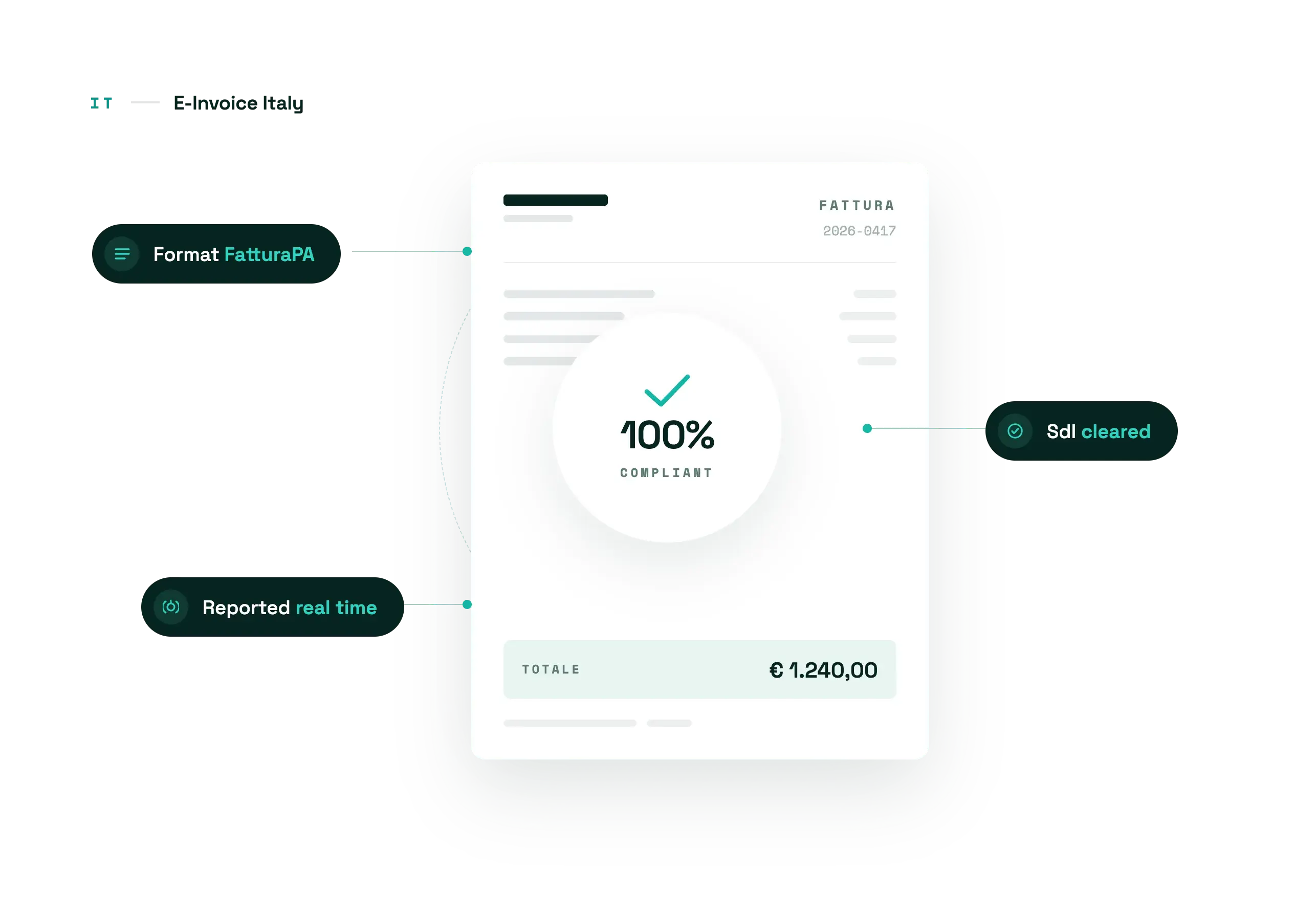
One API to create and clear FatturaPA through SdI (B2B and B2C) and transmit corrispettivi telematici to the Agenzia delle Entrate — the receipt and the invoice from a single integration.
They're separate: corrispettivi covers the receipt, FatturaPA via SdI covers the invoice. Both run on the same unified API and Hub, so you add e-invoicing as a configuration step — not a new project.
In Italy, we support FatturaPA — the national XML format that every domestic B2B invoice must use. You send us invoice data once, through the fiskaly unified API, and we map it into whatever the target market requires — FatturaPA for Italy, XRechnung or ZUGFeRD for Germany, and further formats as you add markets. One integration, per-market compliance handled on our side.
No. Corrispettivi are cloud-based — there's no registratore telematico to install, periodically verify or replace. The same Hub then carries e-invoicing on top.
Yes. Italy, Germany and Belgium run on the same API today, with more markets following. Model the invoice once and output the format each country needs.
Corrispettivi telematici report the transaction to the Agenzia delle Entrate; e-invoicing (FatturaPA) issues and clears the structured invoice through SdI. They're separate obligations — and fiskaly covers both, from one API.



News, guides and analysis on Italian e-invoicing and corrispettivi.
POS providers face fiscalization and e-invoicing at once. Here's why running both through one API beats splitting them across two systems.
Read post
Spain B2B e-invoicing starts 6 October 2027 for businesses with over €8 million in prior-year volume of operations. Dates, formats, status reporting and a plan.
Read post
Most vendor demos answer questions you already knew the answer to. These are the ones that decide what the next years look like. Coverage, certification, what happens when the network drops, who pays when a rule changes, and how you get out.
Read post
See where to meet fiskaly in Q4 2026 — retail, payments, e-invoicing, travel and startup events across five countries. Book a meeting with our team.
Read post
A practical guide to Spain's three invoicing mandates, Crea y Crece, SII, and VERIFACTU, covering who each applies to and how Facturae fits in.
Read post
UBL and CII are XML syntaxes; XRechnung and Factur-X build on them; FatturaPA and Facturae don't. A side-by-side guide to every major EU e-invoice format.
Read post
A clear, jargon-free explanation of what counts as an e-invoice, aimed at anyone just starting to navigate Europe’s e-invoicing requirements right now.
Read post
Clarifying a common misconception: why PDF and paper invoices don't meet most e-invoicing mandates, even though they look fully digital on the surface.
Read post
Italy's e-invoicing mandate applies to all VAT-registered entities, including sole traders. But between deadlines, SDI rejection codes, and digital preservation rules, questions remain. This guide answers the most common ones clearly, without jargon, updated to the 2026 SDI specifications and the ViDA reform.
Read post