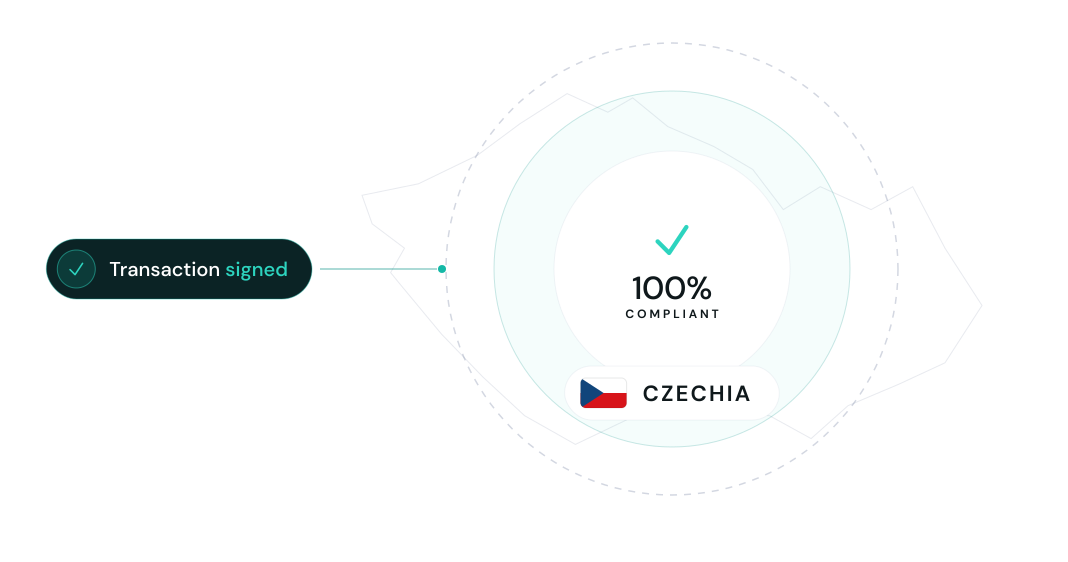









How it works
- A sale happens
Each payment on the transaction is marked as in person or remote — that's what determines whether it's reportable under Czech law, not the payment method itself.
- You call our API
We report only the payments that qualify — never the receipt total. fiskaly handles WS-Security authentication with the Czech Financial Administration (GFŘ) in the background.
- You get a POK code back
Store it. That's your proof of recording and the only confirmation the authority issues.
- The signed exchange is kept
The full signed request and the authority's signed response are stored as evidence, ready for any dispute.
The lightest fiscalization integration we offer
The lightest fiscalization we offer
No device certification. No customer receipt obligation. No receipt signature codes. One message per qualifying payment, one gross amount in CZK. EET 2.0 is an open system by design — no approval process, no audit regime, no certified hardware required from anyone.
No certifications. No tenders. No moats.
Unlike Germany, Austria, France, or Italy, there is nothing to be certified in Czech Republic. The authority made that explicit: vendors and taxpayers carry the responsibility between them. That removes certification timelines and audit costs. Integration speed is controlled by you.
One API, all of Europe
SIGN CZ is part of fiskaly's unified fiscalization platform. Once integrated, expanding to Germany, Austria, Spain, Italy, France, Sweden, or Portugal requires no rebuild — same API, same flow, new country.
The window is shorter than it looks
- 1 November 2026
Registration portal opens
The obligation starts 1 January 2027 — but November is the real deadline. The registration portal opens. Merchants can register business units and generate certificates. Nobody — fiskaly included — can onboard a live Czech taxpayer before this date.
- 1 January 2027
Reporting becomes mandatory
Reporting becomes mandatory for everyone on the same day. No staged rollout by trade.
- 1 February 2027
Pilot phase ends
The January pilot phase ends and full operation starts. The window between portal opening and obligation start is 8 weeks, with every merchant in the country registering at once. Build and test now — registration will be the only step left.
Enterprise-grade security
SIGN CZ is built on security standards that hold up to real scrutiny:
- ISO 27001 certified data centers
- WS-Security with RSA-SHA256 — verified on every authority response before a confirmation is accepted
- Full signed exchange persisted — request and authority response stored verbatim as transmission evidence per transaction
- Authority warnings surfaced on the record, not swallowed
- TLS encryption end to end

Trusted. Proven. Built for scale
99.999%
System uptime
1M+
POS systems active
2,000+
Customers across European fiscalization markets
What it's like to work with us


We were pleasantly surprised at how quickly the fiskaly Cloud TSS could be integrated into our system. Using fiskaly is very easy and can be well integrated into our licensing model. Meanwhile, we recommend that our customers implement fiscalization with fiskaly, as the solution is easy and convenient for our customers.

1 of 5
One integration, every European market
Czech Republic is one market on the same API. Model the transaction once and switch on each country as you expand — Germany, Austria, Spain, Italy, France, Sweden, and Portugal are live today. Build for Czech Republic and you're already most of the way to the next country.
fiskaly SIGN CZ FAQs
No. EET 2.0 is explicitly an open system — no hardware certification, no software approval, no audit regime. The vendor and the taxpayer carry responsibility between them, and the authority offers no binding assessment of whether a given implementation is correct, only an informal helpline.
Probably not for your remote payments. Czech law doesn't sort payments by method — it asks where the customer was standing. A card or QR payment through an online checkout is not recorded; the same card at the till is. Cash is almost always recorded, with one exception: cash on delivery collected by a postal service. That said, any merchant who takes in-person payments must declare every business unit — including their website — even if no recorded sale flows through it.
The Czech authority takes planned weekly maintenance, typically Thursday nights. Legally, the merchant completes the sale and must resend the message within 48 hours of the original transaction — refusing the customer is not a lawful option, and the duty to send survives the deadline. Our platform handles the transmission and confirmation flow, and surfaces unconfirmed records for monitoring.
Yes. The full EET 2.0 integration is testable end-to-end against the Czech Financial Administration's public playground today — no registration required. The law was signed in September 2026. Live production onboarding opens on 1 November 2026, when the authority begins issuing unit numbers and cash certificates.
You need to decide which of your payment flows count as in person — meaning the customer paid at your premises or in your vehicle. This is a product decision on your side, not just a code change, and it usually takes longer than the integration itself. We recommend mapping your flows early: card at the counter, click and collect, split payments, cash on delivery. We handle the reportability logic once you mark each payment.
It's the 39-character confirmation code the GFŘ returns for each accepted sale. It identifies the message, not the sale — and it's your only proof of recording. It cannot be re-obtained once lost, so it must be stored on first receipt.
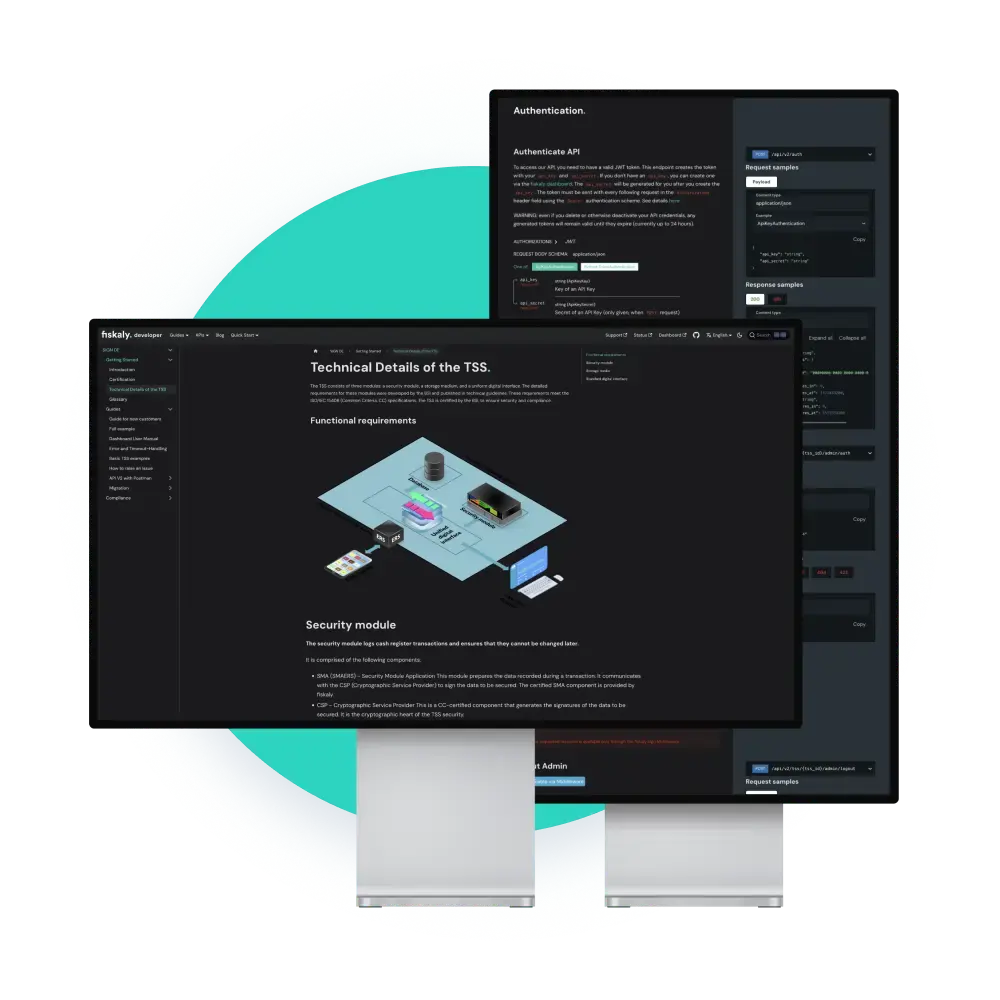
Interested? Request a first meeting
- We're here to help with any questions and find the perfect solution.
- Over 1,900 customers trust our fiscalization solutions. We've got you covered!