


Fiscalization for ERP and omnichannel platforms operating in Sweden
Enterprise platforms with in-person Swedish sales need fiscalization. How to add it at scale, apply it to the right transactions and skip all the hardware.
Read postFrom January 2027, cash registers in Sweden must keep a complete journal and export it to Skatteverket in a defined XML format. SIGN SE Journal adds that to the fiskaly API you already connect to — you extend the integration, you don't rebuild it.
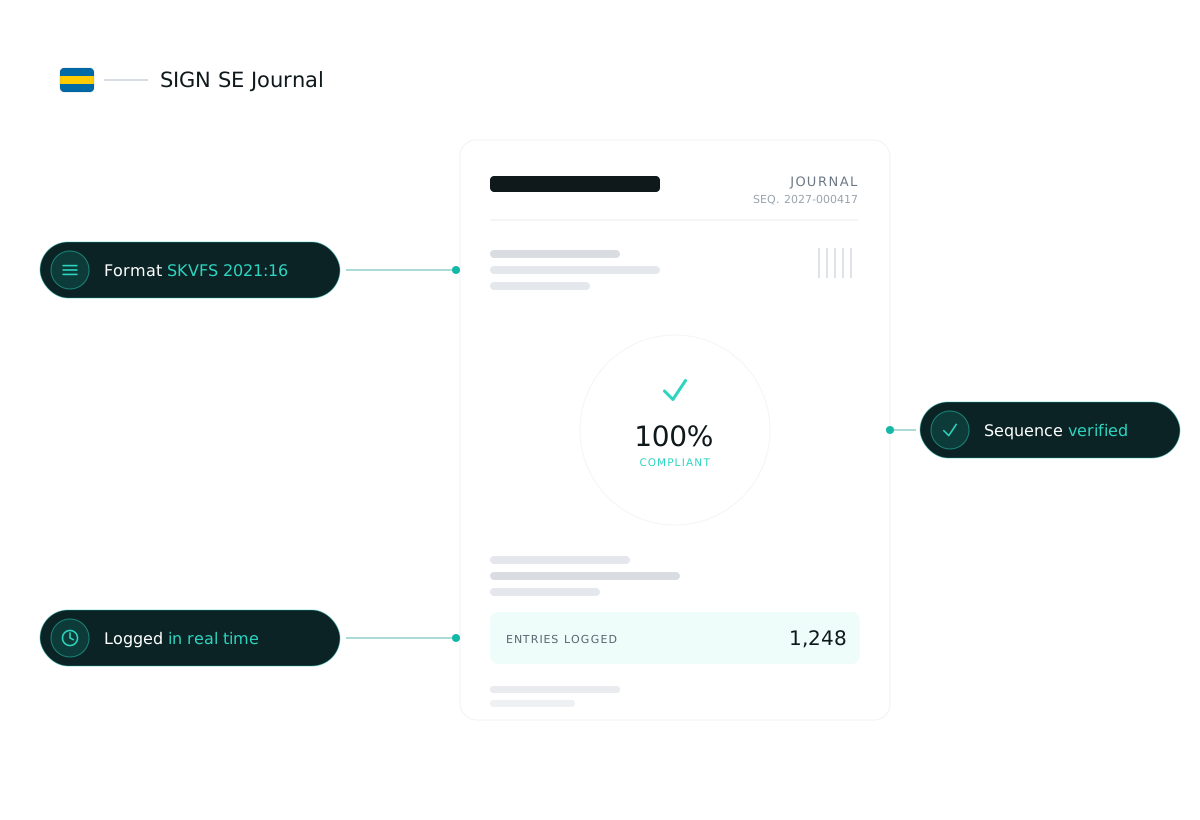





SIGN SE already signs every sale, so each receipt is verifiable. The journal is the full history behind those receipts — every item scanned, edited or deleted, every drawer opened, every login — kept in sequence and exported on demand. The requirement takes effect in January 2027 under Chapter 39 of the Tax Procedure Act (Skatteförfarandelagen), with the export format defined in SKVFS 2021:16. Receipt content and layout rules don't change.
SIGN SE transaction signing on the API, if you're not there already.
Switch on the journal and wire up the export on the same integration.
Run the XML export end to end before the deadline.
You're already compliant, with nothing to do on the day.
| Capability | SIGN SE today | SIGN SE Journal |
|---|---|---|
| Receipts, returns and corrections | IncludedSigned | IncludedSigned |
| Every item scanned, edited or deleted | Not included | IncludedLogged |
| No-sale drawer opens and float changes | Not included | IncludedLogged |
| System events: start, stop, login, training mode | Not included | IncludedLogged |
| XML export for Skatteverket | Not included | IncludedOn demand |
Same API, same credentials, same registers. You add fields and events to the integration you already run, and your live merchants keep working while you do it.
Take transaction signing and the journal together rather than twice. One integration, one contract, and the same authentication pattern you'll reuse in the next market.
Journaling runs on the API you already connect to. You extend what you have instead of starting again.
Nothing to ship, install or maintain at the checkout — and nothing to replace when a device fails.
fiskaly builds the file on request, for the period and registers you choose, in the format Skatteverket expects.
The schema will be revised over time. Tracking Skatteverket is our job, not a permanent line on your backlog.
99.999%
System uptime
more than
10 billion
Transactions processed
certified
ISO 27001
European data residency

Working with fiskaly proved to be a golden opportunity for us. Their cloud-based and user-friendly solution met all our requirements and enabled a smooth implementation of fiscalization. We were not only able to meet the legal requirements, but also easily support our customers and provide them with an optimal fiscalization solution.
1 of 3
Integrate the fiskaly Unified API once, then switch on new countries by changing the data you send — the same login and the same endpoint in every market.
LiveComing soon
SIGN SE Journal is fiskaly's service for Sweden's cash register journal requirement. It records the register's events in sequence and produces the XML export Skatteverket expects, on demand, through the same API as SIGN SE.
No. It runs on the same API, the same credentials and the same registers. You add fields and events to the integration you already have.
No. Journaling happens behind the API. Receipt content and layout rules stay exactly as they are.
January 2027, under Chapter 39 of the Tax Procedure Act, with the journal export defined in SKVFS 2021:16. It affects POS vendors serving the Swedish market.
fiskaly compiles it on request, for the period and the registers you choose. The same path serves ad hoc, X and Z exports.
Yes. SIGN SE Journal runs on the fiskaly Unified API alongside our fiscalization services for Germany, Austria, France, Italy, Spain, Portugal, the Czech Republic and Belgium, with Norway and Denmark following. Talk to us about your footprint.



News, guides and analysis on Swedish cash register rules.
Enterprise platforms with in-person Swedish sales need fiscalization. How to add it at scale, apply it to the right transactions and skip all the hardware.
Read post
For vendors already running fiscalization in Europe, Sweden is an incremental build. What carries over from your markets, what’s new and how to add it.
Read post
Shops, restaurants and hotels all fall under Sweden’s Cash Register Act. Here’s what retail and hospitality POS providers need to build to sell there.
Read post
Every fiscalized sale involves four parties: the business ringing it up, the company that built its POS, the provider of the security component that signs each transaction, and the tax authority that enforces the rules. Here's what each one does, what the law holds it responsible for, and where those lines shift between countries.
Read post
Registering with Skatteverket is a three-step, merchant-led process with a 14-day deadline. Here’s each step, the fields required and where they come from.
Read post
Before a POS vendor scopes a new market, one question decides most of the work. Does the law regulate the software, approve a certified device, or let the business choose? This guide sorts six European markets into the three regimes and explains what each means for your product.
Read post
What happens between “pay” and a compliant receipt in Sweden? A step-by-step look at cloud fiscalization, the control code and the daily status check.
Read post
The Swedish Cash Register Act requires cash-accepting businesses to use a certified register and issue compliant receipts. What POS vendors need to know.
Read post
Every Swedish receipt must show 13 mandatory fields under SKVFS 2021:17, including the tillverkningsnummer and a VAT breakdown. What POS vendors must build.
Read post